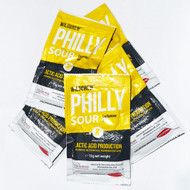
We regularly receive queries on when and how best to use Philly Sour yeast, so we consulted the experts and makers of Philly Sour yeast - Lallemand Brewing.
Philly Sour yeast is a great choice for brewers who want to make sour-style beers quickly and simply, because it produces both alcohol and lactic acid during fermentation. This means you can achieve a clean, refreshing tartness without using bacteria or performing a separate kettle-souring step, reducing time, equipment complexity, and contamination risk. It also ferments reliably like standard brewing yeast, allowing fruity hop-forward or traditional sour beer styles with a smooth, balanced acidity.
Philly Sour is a pure strain of Lachancea spp, a lactic acid-producing yeast isolated from nature. The yeast produces lactic acid from glucose in the wort and ethanol from maltose and maltotriose. Dextrins are not consumed. Philly Sour is not a yeast blend and does not contain bacteria such as lactobacillus and pediococcus. With Philly Sour, the brewhouse is not tied up for 24-48 hours during acidification, as is the case with bacterial kettle souring. Other benefits of using Philly Sour are improved head formation and retention, and improved mouthfeel from glycerol naturally produced by the yeast. In addition, Philly Sour is resistant to hops, meaning worts can be hopped as usual, and there is no requirement to pre-sour the wort, as is the case with kettle souring. However, Philly Sour is easily outcompeted by Ale or Lager yeast, so doesn’t pose a cross-contamination risk in your brewery.
Typically, in standard wort, we would expect Philly Sour to achieve a pH of 3.2-3.5, with a titratable acidity of 3-8g/L. The amount of lactic acid produced can also be influenced by adding dextrose into the wort pre-pitch, by increasing glucose concentration by lowering mash temperature, or by using glucose releasing mash enzymes. Lactic acid is produced first within the first 48-72 hours, with ethanol second and final attenuation reached in around 10 days. Note, too, that for the souring phase of fermentation, there is no heat produced by the fermentation, so the wort temperature will rise or fall to match ambient.
Regarding pitch rate and fermentation temperature, we see success where a high pitch and ferment temperature (25-30˚C) coupled with a lower pitch rate is used. We have observed improved fermentation kinetics and stone fruit/peach characteristics with this method. Alternatively, a lower fermentation temperature (20-25˚C) can be used if the pitch rate increases. The Lallemand pitch rate calculator will provide the target pitch rate for your chosen fermentation temperature and wort strength.
As a guide, in 1.048 OG wort, pitching at 30˚C would require a pitch rate of 0.55 g/L (11 gm in 20 L), whereas, at 20˚C, 1.1 g/L (2 x 11 gm in 20 L) would be needed. In terms of attenuation, we have observed a range of 70-85%, depending on wort makeup. Note that as this is not a ‘regular’ brewing yeast; fermenting at 30˚C doesn’t lead to issues with excessive ester and fusel – so there are no issues with creating off-fermentation character at these temperatures.
Some Philly Sour resources follow:
TDS https://www.lallemandbrewing.com/wp-content/uploads/2021/06/TDS_WILDBREW_PHILLYSOUR_ENG_A4.pdf
Best Practice https://www.lallemandbrewing.com/wp-content/uploads/2021/10/LAL-bestpractices-Philly_Sour-ENG-A4.pdf
Philly Sour Product Video https://www.youtube.com/watch?v=jz-Rwwk0xKg
5 Tips for Fermenting with Philly Sour https://www.youtube.com/watch?v=ERrI0ktxRp0